
OPEN
Paying twice, in a currency the seller never sees
The goods are priced in CNY by someone who does not ship abroad. Getting them to you costs two separate payments, converted twice, with a tax decision in the middle. Here is each part in the order it arrives.
Every rule and threshold below is quoted from a page OrientDig publishes, with the date it was read.
FACT
The price you see, and the currency it settles in
Every listing behind this catalogue is priced in CNY, because every seller behind it is selling inside China. Your card is not. So an exchange rate sits in the middle of the transaction, and it is applied when the payment is taken rather than when you first looked at the item.
That is worth saying plainly because it changes what a price means. The number under a listing is the seller number. The number you pay is that one converted, plus the things the seller never charged you for. On the manual order form all three parts are visible as separate fields, which is the clearest place to see what an order price is actually made of:

Scroll the screenshot to inspect each field.
View full-size imageUnit price and quantity are the seller side. Domestic shipping is what it costs to move the goods from that seller to the agent warehouse inside China, and it is charged whether or not the listing said delivery was free, because a listing offering free delivery is offering it to a Chinese address.
None of these three is the international shipping. That is a separate bill, later, and it is the one worth estimating before any of this.
FACT
Reading the breakdown
What the first amount is made of
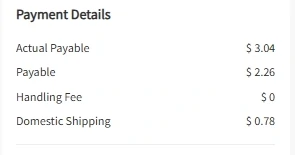
At checkout the same parts appear as a short breakdown. It is worth reading once, slowly, because the vocabulary is not obvious and it never gets explained again.
Payable is the sum of the goods. Domestic shipping is the leg to the warehouse. The handling fee is the agent own charge for doing the buying. Actual payable is what leaves your account, and it is the only line that includes all three.
What is missing from this screen is everything international. No freight, no duty, no tax. The parcel does not exist yet, so nothing about it can be priced.
LOCKS
Two bills, and what each one buys
The split into two payments is the single most confusing thing about ordering this way, and it is entirely logical once you see what the boundary is. The boundary is the warehouse.
First payment: seller to warehouse
This buys the goods and moves them to the agent warehouse in China. It is taken at checkout, before anything has been bought, which is why the money sits with the agent rather than the seller for a while.
Everything on the order form is priced into this one. Nothing about the parcel is, because at this point there is no parcel and no address involved beyond a warehouse in China.
Second payment: warehouse to you
This buys the international leg. It is quoted after the goods are stored, once they have a real weight and a real box, and it is where the choice of line, the declaration and any extra services are paid for.
It is also the payment people underestimate, because it is the one they have not seen yet while they are deciding whether to order. Estimating it first is the advice OrientDig gives on its own returns page, and the reason is on the home page.
LOCKS
The deadline on an order you have not paid for
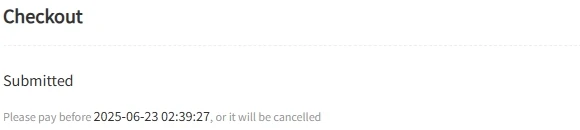
A submitted order is not a held order. The checkout screen carries an expiry, and an order that is not paid by then is cancelled rather than parked.
This is reasonable, because nothing has been bought and prices move, but it catches people who submit an order to see the number and come back tomorrow. The submission was the easy half. The payment is what starts the clock that everything else on this site is about.
If it does lapse, nothing is lost except the order itself. Rebuild it and pay it in the same sitting.
LOCKED
Declaring a parcel, and what customs now charges
The declaration is the last real decision of the whole process and the one with the largest range of outcomes. Two modes are offered, and the difference is how much of it you are choosing.
Personalized declare lets you set the detail
Category, quantity, unit price and total are all editable. This is the mode to use when the parcel holds several different things, because a single blended total describes none of them well.
System declare fills in the total only
Faster, and fine for a simple parcel. You are accepting the number the system works out rather than writing one.
There is a floor, and it is a percentage
The minimum declared value is limited to 30 percent of the value of the goods. A declaration below that is not an option the form will accept, which removes the most common bad idea before anyone has to argue about it.
It is not editable after submission
Once the parcel is submitted the declared total is fixed. There is no correcting it from the tracking page, so read it twice before the parcel goes.
The thresholds moved, and not in your favour
The United Kingdom removed its low value relief on 1 January 2021 and the European Union followed on 1 July 2021. In both places the practical threshold is now zero, so tax is expected on the parcel whatever it is worth. Under 150 euro an IOSS arrangement can collect it up front instead, but OrientDig states that it cannot provide its own IOSS number, so that route depends on the carrier rather than the agent.
Nothing here is a guarantee about clearance
The official wording is careful and worth adopting: no promise that a declaration clears faster, and no promise that you will not be taxed twice. A declaration is a statement, not a negotiation.
Two pages, both read on 2026-09-22. The modes and the floor are set out in the OrientDig help centre under "How to choose a declaration mode personalized declare and system declare", and the tax thresholds are set out in the OrientDig help centre under "Vat reform in the uk and eu countries".
OPEN
Balance or card
What you can actually pay with
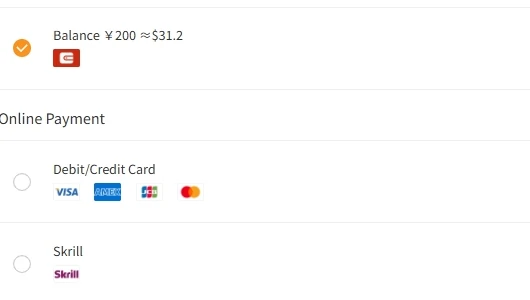
The payment screen is short. There is a stored balance, which is topped up in advance and spends like account credit, and there are the direct routes.
The balance is worth understanding rather than ignoring. Topping it up once and ordering from it means the conversion happens once instead of on every order, and it makes a failed payment a much smaller event. The cost is that the money is sitting with the agent before you have decided what to spend it on.
Cards and the third party wallets do the opposite: nothing is held in advance and every order converts on its own. Neither is wrong. Pick the one that matches how often you order.
LOCKED
Three declarations that get a parcel stopped
A declaration that does not describe the parcel is the fastest way to turn a delivery into an inspection.
The official guidance names three shapes of bad declaration, and they are named because they happen. Three pairs of shoes declared as one dollar. Ten kilograms declared as a single ring. A parcel worth about two hundred dollars declared at a thousand.
The first two are the same mistake: a value or a description that cannot be true for the weight and the box. The third is the one people find surprising, because over-declaring feels safe. It is not; it is simply volunteering more tax than you owe, and it is exactly as inconsistent as under-declaring.
The workable rule is boring. Declare what is in the box, at something that resembles what you paid, above the floor, and take the tax. Every alternative costs more in time than it saves in money.
Examples quoted from the official declaration mode page, read on 2026-09-22. The page itself sits in the OrientDig help centre under "How to choose a declaration mode personalized declare and system declare".