
OPEN
What is allowed to ship, and who decides it
Three separate sets of rules decide whether the thing you just bought ever reaches you: what may be posted, what condition it has to be in, and what the carrier will carry. None of them are checked at checkout.
Every rule on this page is quoted from a page OrientDig publishes, with the date it was read and a link to the original.
LOCKS
When the check happens
Restrictions that are checked before purchase, and the ones that are not
There is an assumption worth killing early: that the order form knows what can be posted. It does not. The mailing restriction on an item is tagged by the person who inspects it, after it has been bought and after it has arrived at the warehouse. At the moment you pay, that field does not exist yet.
You can see exactly where it does exist. The warehouse list has a column headed mail restriction, sitting alongside the product, the stored time, the quantity and the volume weight. It is a column in the warehouse view, filled in by whoever handled the goods, and there is no equivalent anywhere on the order form.
The practical consequence is that the checking you can do before purchase is checking you have to do yourself, against the published lists below. Nothing in the checkout will stop you.
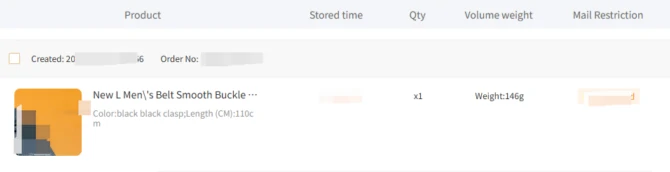
Both read on 2026-09-22. The timing is set out in the OrientDig help centre under "Mailing restrictions setup", and the storage window is set out in the OrientDig help centre under "The duration for which goods can be stored in the OrientDig warehouse is 90 days".
LOCKED
What the prohibited items statement actually covers
This is the published list, grouped. It is longer and stranger than most people expect, and two of the entries catch ordinary shoppers rather than smugglers.
| Group | What is named | Where it catches people |
|---|---|---|
| Rights and copies | Counterfeit and pirated goods, named first on the statement | The statement also says you are responsible for ensuring what you buy does not infringe anyone else rights. That responsibility is not shared. |
| Things you swallow or wear inside | Supplements and medical devices | Vitamins and contact lenses are the usual surprise. Both are ordinary retail purchases in most countries and both are on the list. |
| Signal and money | Wireless transceivers, currency, precious metals | Gold and silver jewellery lands here. So does anything that transmits, which covers a lot of cheap electronics accessories. |
| Heritage and wildlife | Antiques and endangered species products | Rarely an issue for clothing, routinely an issue for anything with bone, shell, horn or exotic leather on it. |
| Raw materials | Wood and charcoal products | The one nobody guesses. A wooden box, a bamboo handle or a charcoal filter can be the reason a parcel is held. |
| Hazard classes | Drugs, explosives, pesticides, asbestos, gambling machines | No ambiguity here, and no route round it. |
| Sensitive goods, removed rather than refused | Essential oils, care solutions, lubricants, batteries, glue | These are a separate rule from the prohibited list. They are taken out of the parcel before dispatch, so the first sign is a lighter box. |
Groups and wording from the official prohibited items statement, read on 2026-09-22. The statement itself says the list is not guaranteed complete. Read the original.
LOCKED
Packing standards that decide whether an item is accepted at all
Separate from what may be posted is what condition it has to arrive in. The special standards page sets thresholds for categories where a used item and a new one look identical in a photograph. These are the specific ones, and they are oddly precise, which is a good sign: precise rules are rules somebody actually applies.
Sneakers keep their tags
New pairs have to arrive with the anti-theft and anti-damage tags uncut. If you or the seller cut them to photograph the shoe, it is no longer being handled as new. This is worth passing to the seller in the message box at order time.
Cosmetics stay sealed
Unsealed cosmetics are not accepted as new. Testers and decanted samples are the usual casualty.
Cameras have a shutter count
A DSLR is accepted as new if the shutter has been pressed no more than 20 times. That is a number you can ask a seller to prove, and it is far more informative than any adjective in the listing.
Large appliances must be untouched
Televisions and air conditioners must not have been wall mounted. Washing machines must not have been water tested. Both are checkable by eye, which is why they are on the list.
Thresholds quoted from the official special standards page, read on 2026-09-22. Find it in the OrientDig help centre under "Special standards".
OPEN
From stored goods to a parcel you can post
Goods in the warehouse are not a parcel yet. You choose which items go together and submit them, and only then does the thing acquire a status you can follow.

Scroll the screenshot to inspect each field.
View full-size imageThis is also the moment the restriction tags from the inspection become real, because a parcel containing something that cannot be posted does not go. Splitting one warehouse full of goods into two parcels is a normal move, and it is usually cheaper than it looks once the weight rules below are understood.
Submitting also swaps one clock for a shorter one. Goods sitting loose in the warehouse are stored for 90 days. A submitted parcel is held free for 30, counted from the point its status reads calculating for shipping fee, and a parcel left unpaid and unanswered past that is treated as abandoned and destroyed. So the safe order of operations is to submit once you are ready to pay the freight, not as a way of tidying up the warehouse.
Two pages, two clocks, both read on 2026-09-22. The 30 day parcel window is stated in the OrientDig help centre under "The duration for which parcel can be stored in the OrientDig warehouse for free is 30 days", and the 90 days for loose goods is stated in the OrientDig help centre under "The duration for which goods can be stored in the OrientDig warehouse is 90 days".
LOCKS
The number people guess wrong
What the freight is calculated on
The parcel screen records two separate measurements, and most people only think about one of them. Weight is in grams and is what the scale says. Volume is in cubic centimetres, printed with the three box dimensions it was worked out from.
Both are there because a carrier prices on whichever of the two costs it more. That is why a down jacket costs more to send than a pair of jeans of the same weight, why compressing a parcel is worth real money, and why adding one small heavy thing to a bulky parcel often costs almost nothing. You were already paying for the air.
Work this out before the order rather than after. The box on the same screen is the shipping fee, and it stays empty until the parcel has been measured, which is exactly the moment it is too late to change what is in it.

OPEN
Packaging is a line item, and it is the cheapest volume you will ever save
Because volume is priced, the shoe box is often the most expensive object in a parcel. The parcel screen treats that as a decision rather than an accident. Every item is listed with its quantity, its weight, its tags and a column for removing its packaging, and there is a single switch above the list that does the same thing to everything at once.

Scroll the screenshot to inspect each field.
View full-size imageIt is the one saving available at this stage that does not change what you bought, and on bulky footwear it is a large one. The trade is real, though. Packaging is protection, and the disclaimers put fragile breakage on the buyer, so stripping the box off something that can crack moves risk onto you for the sake of a smaller box.
Do not confuse this with the tags. The special standards above require new sneakers to arrive with their anti-theft and anti-damage tags uncut, and that is a condition of being accepted at the warehouse, decided long before this screen. Removing a box is your call. Cutting a tag was never on the table.
The value added service column beside it is where anything extra gets attached to a specific item. What each one costs is quoted on the screen itself, which is the only place it stays current. The declaration on the same parcel is a separate decision with tax consequences, covered on paying.
LOCKED
What the list does not promise
The prohibited items statement says in writing that it is not guaranteed to be complete, current or accurate.
That sentence is unusual, and it is worth taking at face value rather than reading it as boilerplate. It means the list is a good-faith summary of a set of rules that are set by carriers and customs authorities in several countries and change without anyone being told.
Paired with it is the other clause: you are responsible for making sure what you buy does not infringe anyone else rights. Between the two, the position is clear. The agent will apply the rules it knows about, and it is not underwriting your purchase.
The useful response is not anxiety, it is sequencing. Check the category against the published list before you pay, keep the parcel simple, and treat anything liquid, powered, wooden or metallic as worth a second look. The rest of the checklist is on before you pay.
Quoted from the official prohibited items statement, read on 2026-09-22. Read the original.